If you’re looking for your first credit card, the Chase Freedom Rise is one of the most beginner-friendly options available. While it won’t impress experienced credit card users with huge welcome bonuses or premium rewards, it wasn’t designed to. Instead, this card focuses on helping people with little or no credit history get approved and begin building a strong financial foundation.
In this Chase Freedom Rise review, we’ll cover the welcome offer, cash back rewards, approval tips, upgrade opportunities, fees, and whether this starter card is worth getting.
Chase Freedom Rise Welcome Bonus
The Chase Freedom Rise currently comes with two introductory offers.
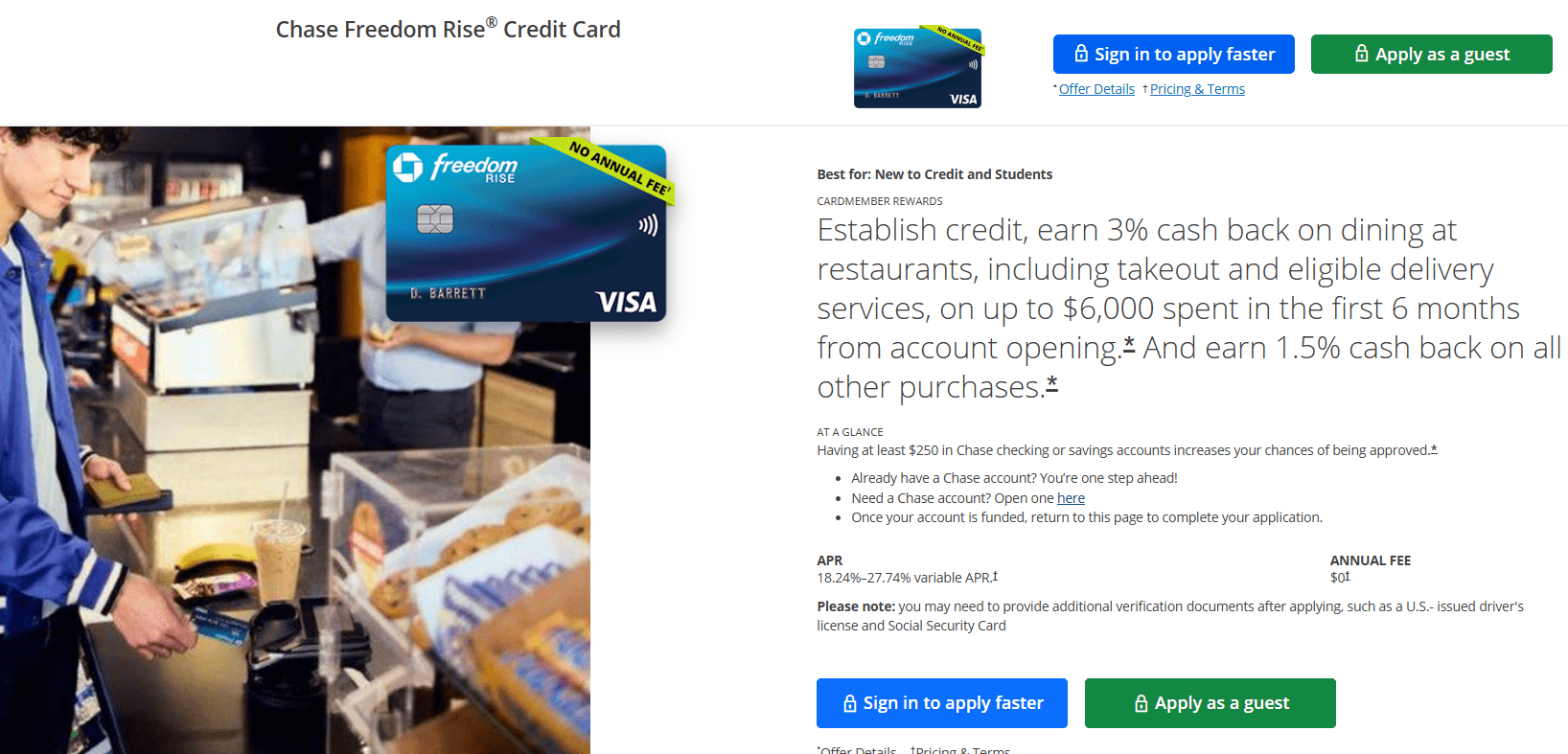
The first is a limited-time promotion that gives you 3% cash back on dining during your first six months, on up to $6,000 in dining purchases. If you spent the full amount, you could earn a maximum of $180 in cash back. However, most new cardholders will likely earn somewhere between $30 and $80 from this offer, depending on their spending habits.
The second offer is a $25 statement credit when you enroll in automatic payments within the first three months after opening your account and remain enrolled for at least 90 days.
Although $25 may not sound exciting, it’s actually one of the more valuable perks for first-time credit card users because it encourages the habit of paying your bill on time. Setting up autopay can help you avoid missed payments and build a positive credit history.
Combined, most new cardholders can realistically expect to receive between $60 and $200 in total first-year bonuses.
Compared to cards like the Chase Freedom Unlimited or Chase Freedom Flex, which often offer a straightforward $200 welcome bonus after meeting a spending requirement, the Freedom Rise bonus is smaller. That’s intentional, as this card focuses on approval rather than maximizing introductory rewards.
How the Chase Freedom Rise Earns Cash Back
The Chase Freedom Rise has one of the simplest rewards structures among beginner credit cards.
For the first six months after opening your account, you’ll earn:
- 3% cash back on dining purchases, up to $6,000 in spending.
- 1.5% cash back on all other purchases.
Once the promotional dining period ends—or after reaching the spending cap—the card earns a flat 1.5% cash back on every purchase.
There are no rotating categories, activation requirements, or spending caps to monitor after the introductory period ends.
It’s important to remember that the 3% dining rate is temporary. Long term, the Chase Freedom Rise functions as a straightforward 1.5% cash back card. While that may seem modest, it’s actually the same base earning rate offered by the Chase Freedom Unlimited on general purchases.
The Hidden Approval Boost Most People Miss
One of the biggest advantages of the Chase Freedom Rise isn’t the rewards—it’s the approval process.
Chase specifically notes that applicants who maintain at least $250 in a Chase checking or savings account may have significantly better approval odds.
For people with little or no credit history, this can make a major difference.
If you’re planning to apply for the card and don’t already bank with Chase, a smart strategy is to:
- Open a Chase checking account.
- Deposit at least $250.
- Wait several weeks after opening the account.
- Apply for the Chase Freedom Rise.
This simple step can substantially improve your chances of approval.
For younger applicants, certain Chase youth checking accounts may also qualify for this approval advantage.
The Automatic Upgrade to Chase Freedom Unlimited
Perhaps the biggest reason to choose the Chase Freedom Rise is its built-in upgrade path.
Chase automatically reviews eligible Freedom Rise accounts each year. If you satisfy several conditions, your account may be upgraded to the Chase Freedom Unlimited without requiring a new application or hard credit inquiry.
Generally, you’ll need to:
- Keep your Freedom Rise account open.
- Make at least one purchase during the previous 12 months.
- Maintain on-time payments across all of your credit accounts.
- Keep your Chase accounts in good standing.
If approved for the upgrade, you’ll keep:
- Your existing account history.
- Your credit limit.
- Your card number.
You’ll simply transition to a stronger rewards card.
Since the Chase Freedom Unlimited earns higher rewards in several categories—including dining, drugstores, and travel booked through Chase Travel—this upgrade represents significant long-term value.
Rather than viewing the Freedom Rise as a permanent card, think of it as your entry point into the Chase credit card ecosystem.
Fees, APR, and Important Terms
The Chase Freedom Rise keeps costs relatively simple.
Key features include:
- No annual fee.
- Variable APR ranging from approximately 18.24% to 27.74%, depending on creditworthiness.
- No minimum cash back redemption amount.
- Cash back never expires while your account remains open.
Rewards can be redeemed in several ways, including:
- Statement credits.
- Deposits into eligible Chase checking or savings accounts.
- Gift cards.
- Purchases through Amazon checkout.
One important limitation is that the Chase Freedom Rise does not include an introductory 0% APR offer. If you need to finance a large purchase or transfer existing debt, other Chase cards are better suited for that purpose.
As with any rewards credit card, carrying a balance quickly outweighs the value of any cash back you earn due to interest charges. Paying your statement balance in full every month is essential.

Who Should Get the Chase Freedom Rise?
The Chase Freedom Rise is an excellent fit for several types of consumers.
First-Time Credit Card Users
If you’ve never owned a credit card before or have almost no credit history, this is one of the easiest Chase cards to qualify for.
Students and Recent Graduates
Many student credit cards offer lower rewards than the Freedom Rise. This card provides competitive earnings while also creating a pathway toward better Chase products.
Existing Chase Banking Customers
If you already have a Chase checking or savings account, you may benefit from the approval boost without taking any additional steps.
People Building a Long-Term Chase Strategy
For anyone planning to eventually build the popular Chase “Trifecta” strategy with cards like the Chase Sapphire Preferred and Chase Freedom Unlimited, the Freedom Rise provides a smooth entry point.
Who Should Skip the Chase Freedom Rise?
Despite its strengths, the Chase Freedom Rise isn’t the right card for everyone.
You may want to look elsewhere if:
You Already Have Good Credit
If you’ve successfully managed another credit card for several years, you can likely qualify directly for the Chase Freedom Unlimited or Chase Freedom Flex, both of which offer stronger rewards and larger welcome bonuses.
You Want the Biggest Welcome Bonus
Even under ideal circumstances, the Freedom Rise’s total introductory value tops out around $200.
Other Chase cards regularly offer a flat $200 bonus after meeting relatively modest spending requirements.
You Carry Credit Card Balances
The relatively high variable APR makes carrying a balance expensive. Interest charges can quickly eliminate any rewards you earn.
You Don’t Plan to Stay With Chase
The biggest advantage of this card is its automatic upgrade path. If you don’t intend to remain within the Chase ecosystem, another bank’s starter card may offer more value.
Important Things to Know Before Applying
Before submitting an application, keep two important Chase rules in mind.
First, applying for the Chase Freedom Rise results in a hard inquiry on your credit report. Multiple credit applications submitted within a short period can temporarily lower your credit score.
Second, the Chase 5/24 rule still applies. If you’ve opened five or more personal credit cards with any issuer during the previous 24 months, Chase will typically decline your application regardless of your credit score.
Fortunately, most first-time applicants won’t come close to this limit.
Final Verdict: Is the Chase Freedom Rise Worth It?
The Chase Freedom Rise isn’t designed to compete with premium rewards cards or generous welcome bonuses. Instead, it fills an important role as one of the strongest starter credit cards for people new to credit.
Its straightforward rewards, no annual fee, higher approval odds for Chase banking customers, and automatic upgrade path to the Chase Freedom Unlimited make it an excellent long-term starting point.
If you’re building credit for the first time and want a simple path into Chase’s ecosystem, the Chase Freedom Rise is absolutely worth considering. However, if you already have established credit or qualify for stronger Chase cards, you’ll likely receive more value by applying directly for the Freedom Unlimited or Freedom Flex instead.