M1 Finance is a distinctive investing platform that merges the ease of automation with the flexibility of customization. Since its launch in 2015, it has attracted a broad audience of investors by offering an intuitive, low-cost way to manage a personalized portfolio. With over $10 billion in assets under management, M1 Finance has positioned itself as a modern alternative to both traditional brokers and robo-advisors.
In this detailed M1 Finance review, we will explore the types of accounts it offers, its investment options, platform usability, fee structure, unique features, and customer support. We’ll also weigh the pros and cons to help you determine whether it’s the right platform for your investment goals.
Account Types Offered by M1 Finance
M1 Finance provides a wide range of account types to suit different investment needs and life stages:
1. Brokerage Accounts
These include both individual and joint taxable accounts. You can invest in stocks, ETFs, and even cryptocurrencies through this account type.
2. Retirement Accounts
M1 supports Traditional, Roth, and SEP IRAs. To open any of these, a $500 minimum initial deposit is required.
3. Custodial Accounts
These allow parents and guardians to invest on behalf of a minor. They’re a great way to build wealth early for a child’s future.
4. Trust Accounts
M1 offers both revocable and irrevocable trust accounts, though these require a minimum of $5,000 to open.
5. Crypto Accounts
Users can invest directly in popular cryptocurrencies like Bitcoin and Ethereum without needing to use a separate platform.
Investment Options on M1 Finance
M1 Finance focuses on three main types of assets: stocks, ETFs, and cryptocurrencies.
Stocks and ETFs
You have access to over 6,000 stocks and ETFs. The platform also supports fractional shares, which means you can invest in high-priced stocks like Amazon or Google without needing the full share price—ideal for investors with smaller budgets.
Cryptocurrency
Unlike many traditional brokers, M1 Finance allows you to invest in crypto assets directly. However, keep in mind that the platform does not support mutual funds, options trading, or Forex, which could be a limitation for more advanced traders.
Platform Usability and Interface
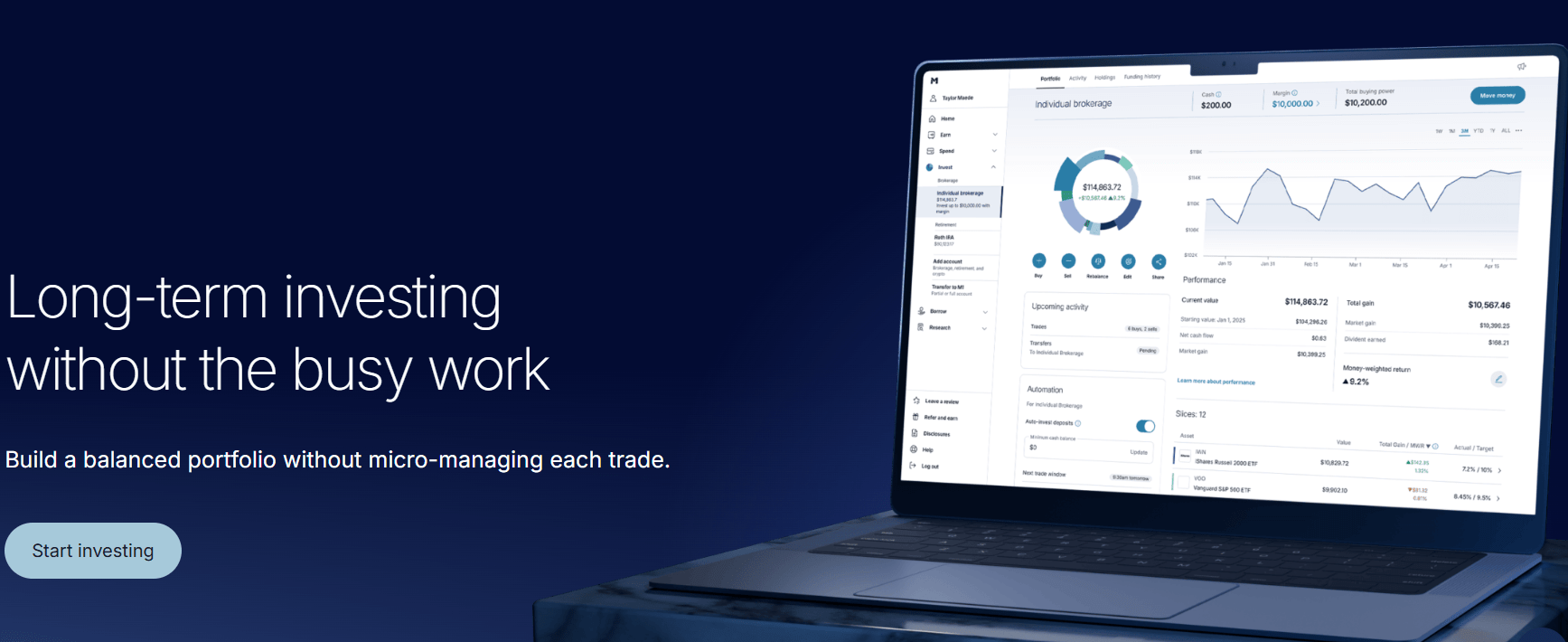
M1 Finance uses a “Pie” model for investing. Each “pie” is a visual representation of your portfolio, composed of various “slices” (stocks or ETFs). You can create your own custom pie or use pre-built “Expert Pies” designed by M1’s research team to match specific investment strategies.
Building a Pie
To create your pie:
- Click “Invest” > “Choose Securities”.
- Add your chosen stocks or ETFs (e.g., VTI, SCD, VOO).
- These selections appear in a basket at the bottom.
- Click “Add”, then “Save” to finalize your pie.
When you fund your pie, the money is split equally across all slices unless you set specific allocations.
Buying and Selling
- Buying: Click “Buy,” enter your desired investment amount, and confirm. M1 Finance will divide your funds according to the pie allocation.
- Selling: Click “Sell,” enter an amount, and M1 will sell shares proportionally. Note: you must turn off Auto Invest before selling.
Important Limitation: Scheduled Trading
M1 executes trades once per day, currently at 2 p.m. ET. This lack of real-time trading is a key consideration for more active investors.
Customizing and Managing Your Portfolio
You can update your portfolio at any time:
- Use “Edit” to add or remove slices.
- To add a new asset (e.g., QQQ), search and select it, then assign a percentage allocation.
- Allocations must total 100%.
M1 also features a “Rebalance” button to automatically return your portfolio to its original target allocation. This is useful when certain assets grow or shrink disproportionately.
Fees and Costs
M1 Finance’s fee structure is mostly low-cost and transparent:
$0 Trading Fees
There are no fees for trading stocks, ETFs, or cryptocurrencies.
$3 Monthly Platform Fee
Accounts with less than $10,000 are charged a $3 monthly platform fee. This can be waived if your balance exceeds $10,000, you place at least one trade in the billing cycle, or you have an M1 personal loan.
No Management Fees
Unlike many robo-advisors, M1 does not charge a percentage-based management fee, making it appealing to cost-conscious investors.
Extra Features That Add Value
Earn Program
Offers up to 4% APY on cash held in the high-yield savings account. This account is FDIC-insured up to $4.75 million via M1’s banking partners.
Credit Card
M1 issues a rewards credit card offering up to 10% cashback in select spending categories (e.g., Netflix, McDonald’s, Starbucks). Other categories include 5% and 2.5% tiers.
Borrowing Options
- M1 Borrow allows users to take margin loans at competitive rates (currently 6.25%) if your account has at least $2,000.
- Personal loans are also available at rates as low as 7.99%, depending on creditworthiness and account status.
Pros and Cons of M1 Finance
✅ Pros
- Commission-Free Trades: $0 fees on stocks, ETFs, and crypto.
- Fractional Shares: Invest with as little as $5.
- Automated Portfolio Management: Includes automatic rebalancing.
- Custom Portfolios: Full control over your allocations with the Pie system.
- Access to Crypto: Integrated directly into the platform.
- Low Borrowing Rates: Great for users who want liquidity without selling investments.
❌ Cons
- No Real-Time Trading: Trades execute in batches, not instantly.
- No Mutual Funds or Options: Limited asset classes compared to full-service brokers.
- $3 Monthly Fee for Small Accounts: Can be a burden for new investors.
- Learning Curve: New users may feel overwhelmed by the pie system and allocation options.
Final Thoughts
M1 Finance strikes a compelling balance between automation and investor control. It’s an ideal choice for long-term, passive investors who want the ability to customize their portfolio without managing trades daily. With no commissions, fractional shares, and access to crypto, it lowers the barrier to entry for newer investors while still offering tools useful to more experienced users.
However, if you’re a day trader, need access to mutual funds or options, or prefer real-time execution, M1 Finance may not meet your needs.
Bottom Line:
M1 Finance is best for hands-off investors who still want a say in what they own. Its smart automation, low costs, and robust customization make it a worthy contender in the modern investment space.