Public.com has quickly emerged as a recognizable name in the online brokerage world, offering a streamlined, commission-free investing experience that emphasizes transparency and community. Founded in 2019, this platform aims to modernize how people approach investing, making it accessible to both beginners and more seasoned investors alike.
In this Public Investing Review, we’ll take an in-depth look at what the platform offers, how it operates, and where it stands in comparison to other brokers. We’ll cover account types, investment options, fees, usability, and some of the platform’s more unique features. Whether you’re just getting started or evaluating new platforms, this review will help you assess if Public.com aligns with your financial goals.
Account Types Available on Public
Public.com offers a solid selection of account types designed to fit different investment needs:
- Individual Taxable Brokerage Accounts: These allow users to buy and sell stocks, ETFs, options, cryptocurrencies, and bonds.
- Retirement Accounts (IRAs): Includes Traditional and Roth IRAs.
- Treasury Accounts: Lets users invest in U.S. Treasury Bills for safer, low-risk returns.
- High-Yield Cash Accounts: FDIC-insured accounts with competitive interest on uninvested cash.
Each of these accounts comes with a specific set of tools and features to suit different investing styles, whether you’re focused on long-term retirement savings or short-term tactical plays.
Investment Options on Public
One of the strongest aspects of this platform, as highlighted in this Public Investing Review, is the variety of investment products available. Here’s what users can invest in:
1. Stocks and ETFs
Public offers access to thousands of U.S.-listed stocks and exchange-traded funds (ETFs), all with zero trading commissions. Investors can even purchase fractional shares, making it possible to diversify a portfolio with limited capital.
2. Options Trading
Traders can buy and sell options contracts without per-contract fees. In fact, Public offers rebates between $0.06 to $0.18 per contract based on monthly volume—an incentive model rarely seen on mainstream platforms.
3. Cryptocurrencies
Through a partnership with Bakkt, Public allows users to invest in leading cryptocurrencies such as Bitcoin and Ethereum. The process is integrated into the main platform, making it simple to move between asset classes.
4. Bonds
With access to over 10,000 corporate and U.S. Treasury bonds, investors can use Public’s bond screener tool to identify fixed-income opportunities.
5. Alternative Assets
The platform also includes less conventional assets like art and collectibles, supporting portfolio diversification beyond traditional asset classes.
Fees and Pricing Structure
Another critical component of this Public Investing Review is its fee structure. Public’s pricing is mostly competitive, with a few caveats:
- Stocks & ETFs: Zero commission.
- Options: No contract fees, plus per-contract trading rebates.
- Crypto: Fees vary by transaction size, maxing out at 1.25% for trades over $500.
- OTC and Extended Hours Trades: $2.99 fee per trade unless you’re a premium member.
Premium Membership
Public Premium costs $10 per month or $96 annually. It includes:
- Extended hours trading (4 a.m. – 8 p.m. EST)
- Advanced analytics and data (e.g., KPIs, Morningstar insights)
- Priority customer service
- Custom investment plans
For active users or those needing in-depth analysis, the subscription could be worthwhile. However, more passive investors might find limited value.
How to Buy and Sell Stocks and ETFs on Public
Using Public.com to trade is intuitive. Here’s a simplified walkthrough of how the process works:
- Search for a Stock or ETF
Use the search bar at the top-middle section of the dashboard. - Asset Details
Once selected, you’ll see detailed stats including dividend yield, expense ratio, top holdings, and historical returns. For example, the Schwab U.S. Dividend Equity ETF (SCHD) was shown to average over 10% annual returns. - Buy Process
You can buy in either shares or dollars. After selecting the amount and order type (market is default), click Review Order and then Submit. - Sell Process
Go to your portfolio, select the asset, and choose Sell. Decide on amount and review the small fee (e.g., $0.02 for a $10 trade). Tip pop-ups appear but are optional.
This straightforward experience is great for newcomers, though advanced traders may find it lacking in terms of speed and depth of tools.
Platform Usability and Interface
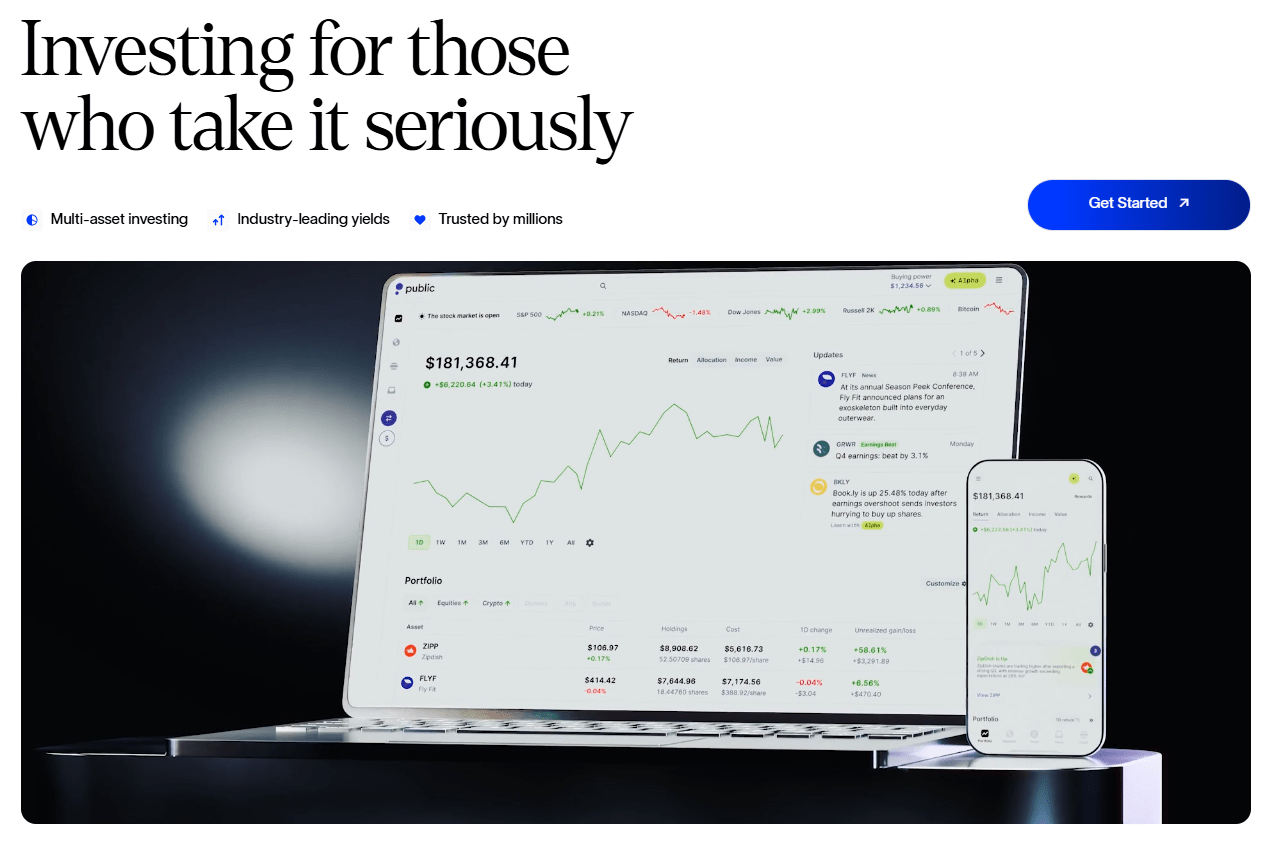
Public.com’s platform is designed for simplicity. The layout is clean and modern, with a focus on visual elements like pie charts for allocation and real-time value tracking. Users can view estimated dividend income, yield expectations for treasury and bond accounts, and current crypto market performance—all from the dashboard.
The addition of recurring investment options and curated “investment plans” (essentially themed mini-portfolios like high-dividend stocks) further enhances user experience. However, the lack of advanced charting tools might disappoint technical traders.
Additional Features
This Public Investing Review would be incomplete without highlighting some extra features the platform offers:
- Fractional Shares: Invest in high-priced stocks like Amazon or Tesla with as little as $1.
- Social Investing: Follow other investors, share thoughts, and learn from the community.
- No Payment for Order Flow: Public doesn’t accept payment for order flow, which helps ensure better transparency in trade execution.
- High-Yield Accounts: Includes cash accounts (4.1% APY), bond accounts (up to 6.5%), and treasury accounts (around 4.07%).
The social component especially sets Public apart, appealing to newer investors looking for guidance or interaction.
Pros and Cons of Public.com
Pros:
- Commission-free trades for stocks, ETFs, and options
- Fractional share investing
- Social features encourage learning and sharing
- Transparency in fee structure and trade execution
- Access to multiple asset classes, including crypto and bonds
Cons:
- Advanced trading tools are lacking
- Mutual funds not supported
- Some key features behind paywall (Premium)
- Tip prompts during trades may be off-putting
- Crypto fees can be higher than on dedicated exchanges
Final Thoughts: Should You Use Public?
To conclude this Public Investing Review, it’s clear that Public.com delivers a user-friendly and transparent experience, especially for those just entering the investing world. It offers a broad selection of assets, zero commission structure, and a strong educational and community-driven ecosystem.
That said, it might not satisfy everyone. Traders who rely on technical analysis, need real-time data overlays, or want access to mutual funds might find Public’s offerings too limited. Likewise, while Premium may unlock powerful features, casual investors might not find it necessary.
Still, as a commission-free platform with easy access to diversified assets, Public.com is a compelling choice—particularly for those who value simplicity, social learning, and a modern interface.