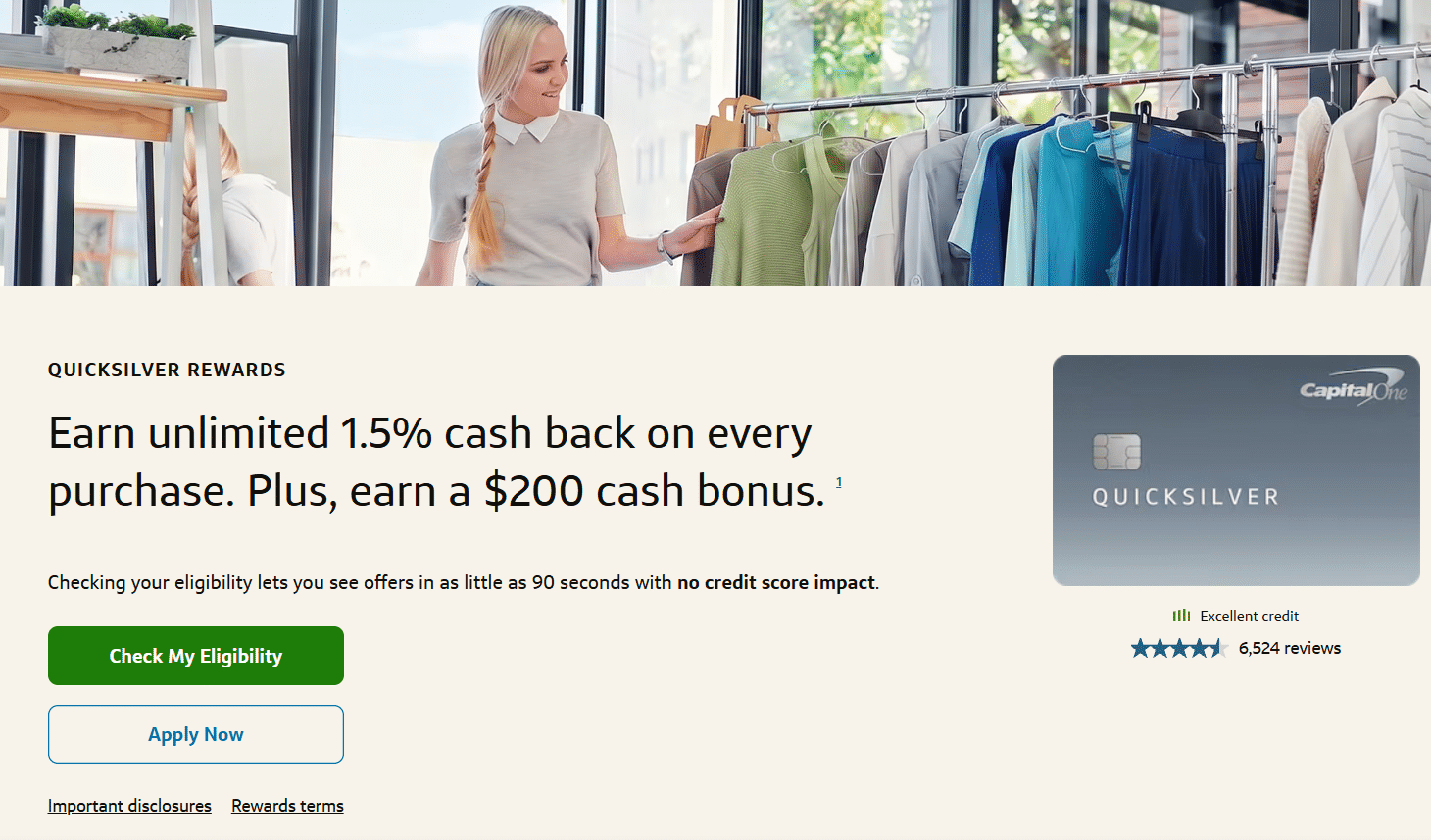
If you are considering the Capital One Quicksilver credit card, you may be wondering whether its simple cash-back structure makes it worth getting. The card offers a straightforward rewards system, a $0 annual fee, an introductory APR period, and no foreign transaction fees.
It also has a feature that can make it more interesting for people who use other Capital One miles cards. You may be able to convert your Quicksilver cash back into Capital One miles and use those miles with travel partners.
Here is what you need to know about the card, including its welcome bonus, rewards, fees, travel benefits, and how it compares with Capital One Savor.
How to Earn the $200 Welcome Bonus
The current welcome offer is a $200 cash bonus after you spend $500 within the first three months of opening the account.
There are no spending tiers or complicated categories to track. You simply need to reach $500 in qualifying purchases during the first three months.
Once you qualify, Capital One says the $200 bonus will be added to your rewards balance within two billing cycles.
There is also an eligibility requirement to keep in mind. Existing or previous Quicksilver cardholders may not qualify for the new-cardmember bonus if they received a bonus for this product within the past 48 months. Check the specific offer terms before applying.
How the Capital One Quicksilver Earns Cash Back
The Capital One Quicksilver uses a simple rewards structure:
- 1.5% cash back on everyday purchases
- 5% cash back on hotels and vacation rentals booked through Capital One Travel
- 5% cash back on rental cars booked through Capital One Travel
- 5% cash back on activities booked through Capital One Travel
- 5% cash back on eligible Capital One Entertainment purchases
The biggest advantage is simplicity. There are no rotating quarterly categories or bonus categories that you need to activate.
For everyday purchases, you earn a flat 1.5% cash back. That means $100 in eligible purchases earns $1.50 in cash back.
For someone who does not want to keep track of different spending categories, the Capital One Quicksilver is relatively easy to manage.
How to Convert Cash Back Into Miles
One of the more interesting features of the Capital One Quicksilver is the ability to potentially convert your cash back into Capital One miles if you also have an eligible Capital One miles card, such as Venture, Venture X, or VentureOne.
The conversion is straightforward. One dollar of Quicksilver cash back can become 100 Capital One miles.
That means the $200 welcome bonus could become 20,000 Capital One miles.
Those miles can then potentially be transferred to Capital One’s travel partners, including programs such as Air Canada, British Airways, Air France, and Turkish Airlines. Transfer ratios and redemption values vary, so compare the number of miles required with the cash price of the flight or hotel before transferring.
There is an important difference depending on which Capital One miles card you have.
If you have Venture or Venture X, those cards earn 2 miles per dollar on ordinary purchases. In that situation, using Quicksilver for everyday spending would generally earn fewer rewards than using the Venture card.
If you have VentureOne, the calculation is different. VentureOne earns 1.25 miles per dollar on ordinary purchases, while Quicksilver can effectively become 1.5 miles per dollar after converting the cash back into miles.
If you do not have an eligible Capital One miles card and do not plan to get one, this conversion strategy does not apply. You would simply use Quicksilver as a 1.5% cash-back card.
Capital One Quicksilver Fees and Introductory APR
The Capital One Quicksilver has a $0 annual fee, so there is no yearly charge simply for keeping the card open.
The card also offers an introductory 0% APR period of 15 months on new purchases and balance transfers. After the introductory period, the variable APR can range from 18.49% to 28.49%, depending on your creditworthiness and the terms offered to you.
A balance transfer fee applies when you transfer a balance. Before transferring debt, compare the fee with the amount of interest you expect to save.
The 0% introductory period can be useful, but it is important to have a plan for paying off the balance before the introductory period ends. Carrying a balance at a high variable APR can quickly cost more in interest than you earn in cash back.
Using Capital One Quicksilver Abroad
Another useful feature is the lack of foreign transaction fees.
That means you can use the card for purchases outside the United States without paying an additional foreign transaction fee on each transaction.
This can make the Capital One Quicksilver convenient for international travel, especially if you want a no-annual-fee card that you can use abroad.
How to Redeem Your Cash Back
Redeeming Quicksilver rewards is straightforward, and your cash back does not expire while your account remains open.
There is also no minimum redemption amount. Depending on the redemption options available to you, you can use your rewards for:
- A statement credit
- A check
- Covering a recent purchase
- Gift cards
- Eligible purchases through Amazon
- Eligible purchases through PayPal
The flexibility means you do not have to wait until you accumulate a large rewards balance before using your cash back.
Additional Capital One Quicksilver Benefits
The card also comes with additional benefits that may be useful depending on your eligibility and the specific terms attached to your account.
Eligible cardholders can enroll in complimentary Hertz Five Star status. Eligible purchases may also receive extended warranty protection.
Virtual card numbers can provide an additional layer of security when shopping online by allowing you to use a virtual number instead of your physical card number.
Because benefits and eligibility can change, check the current cardmember terms before relying on a particular benefit.
How Quicksilver Compares to Savor
Capital One Savor is another no-annual-fee option that may appeal to people comparing Capital One cards.
Both cards offer no annual fee, no foreign transaction fees, and 5% rewards on certain purchases through Capital One Travel.
The main difference is how they reward everyday spending.
Savor offers 3% cash back on eligible purchases in categories such as groceries, dining, entertainment, and popular streaming services. Certain retailers, including Walmart and Target, may be excluded from the grocery category.
Quicksilver instead offers a flat 1.5% on ordinary purchases.
Savor also offers 8% cash back through Capital One Entertainment, while Quicksilver offers 5% on eligible Capital One Entertainment purchases.
How to Choose Between Quicksilver and Savor
The best way to compare the two cards is to look at your actual spending rather than assuming one card will earn more for everyone.
With Savor, you can calculate 3% on eligible grocery, dining, entertainment, and streaming purchases and 1% on other purchases.
With Quicksilver, you can calculate 1.5% on your ordinary purchases.
For example, if a large portion of your monthly spending falls into Savor’s 3% categories, Savor may generate more rewards. If most of your spending falls outside those categories, Quicksilver’s flat 1.5% rate may be more competitive.
Simplicity is another consideration. Quicksilver lets you earn the same everyday rate without thinking about which category you are purchasing from.
The introductory APR period is another difference worth checking when comparing the cards, particularly if you are planning a large purchase or considering a balance transfer.
Looking at one or two months of your credit card statements can give you a realistic idea of which rewards structure fits your spending.
Who Is the Capital One Quicksilver For?
The Capital One Quicksilver is designed for people with excellent credit who want a straightforward, no-annual-fee cash-back card.
It can make sense if you want:
- A simple 1.5% cash-back rate on everyday purchases
- No annual fee
- No foreign transaction fees
- A 0% introductory APR period
- Access to Capital One’s rewards ecosystem
- The potential to convert cash back into Capital One miles
It can be particularly interesting if you already use Capital One miles cards and want another way to accumulate rewards.
When Quicksilver May Not Be the Right Fit
Quicksilver may not be the best match if a large percentage of your spending is on dining, groceries, entertainment, and streaming services, because Savor offers higher rewards on eligible purchases in those categories.
It may also not be the right choice if your primary goal is the highest possible flat-rate cash back. Some no-annual-fee cards offer 2% cash back on ordinary purchases, so it is worth comparing the complete package rather than looking only at the headline rewards rate.
If you have fair credit, you may also want to look at other Capital One products designed for different credit profiles. If you have little or no credit history, a student or secured card may be more appropriate.
Most importantly, a cash-back card is generally not a good reason to carry a balance. Interest charges can quickly outweigh the rewards you earn.
How to Check Capital One Quicksilver Eligibility Before Applying
Applying for a credit card can result in a hard inquiry on your credit report.
Capital One allows prospective applicants to check whether they are pre-approved for available offers before submitting a formal application. According to the issuer, this eligibility check can be completed without affecting your credit score.
It is worth checking your available offers before applying so you can see which products you may qualify for.
Capital One does not publish a fixed rule governing exactly how frequently you can apply for its cards. However, recent applications, hard inquiries, and newly opened accounts can all be relevant factors when applying for new credit.
How to Decide If Quicksilver Fits You
The Capital One Quicksilver is built around simplicity. You get a $0 annual fee, a flat 1.5% cash-back rate on everyday purchases, no foreign transaction fees, and the possibility of converting cash back into Capital One miles if you have an eligible miles card.
Its $200 welcome bonus also has a relatively low $500 spending requirement during the first three months.
The main trade-off is the 1.5% everyday cash-back rate. If you spend heavily in categories rewarded at higher rates by another card, you may earn more with a different rewards structure.
Before applying, compare the welcome bonus, everyday rewards, travel fees, introductory APR, and benefits with your actual spending habits. That will give you a clearer picture of whether the Capital One Quicksilver fits the way you use a credit card.