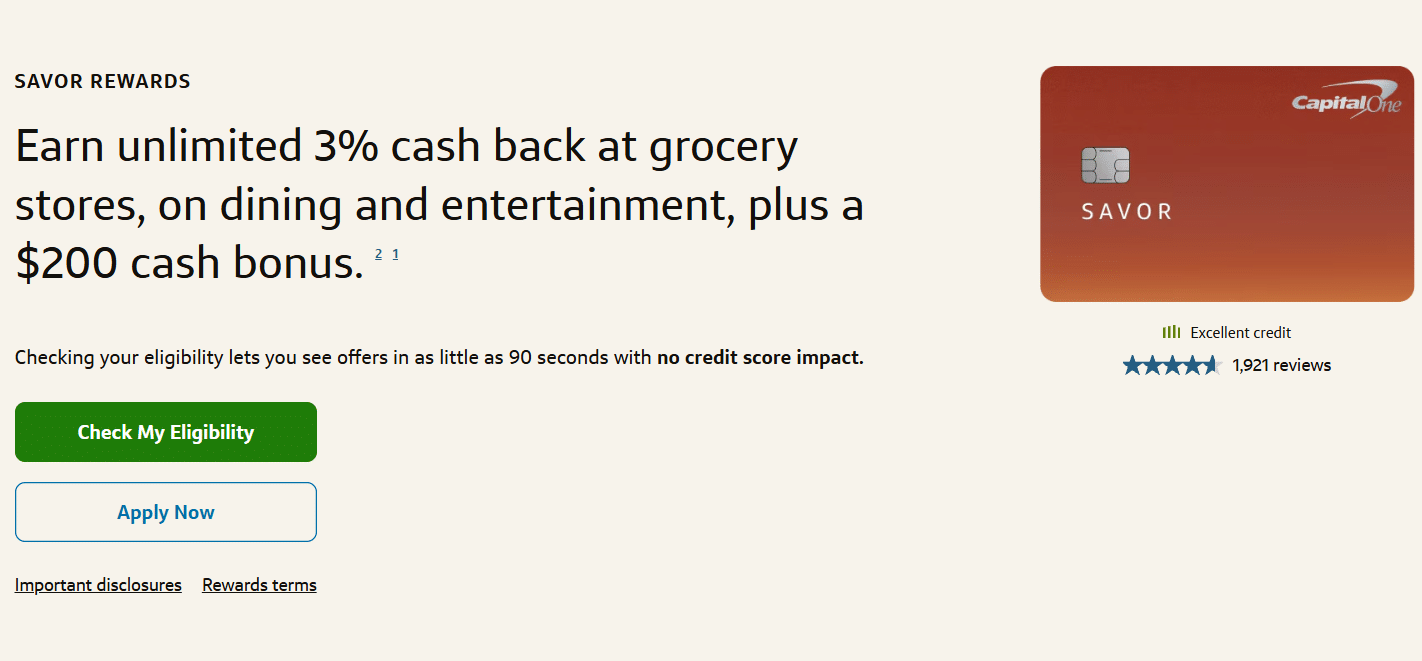
If you are considering the Capital One Savor credit card, it is worth understanding how its welcome bonus, cash back categories, travel benefits, and introductory APR work before applying. With no annual fee and elevated rewards on food and entertainment, the Capital One Savor can be especially useful for people who spend heavily in those categories.
How to Earn the $200 Welcome Bonus
The current welcome offer is a $200 cash bonus after you spend $500 within the first three months of opening the account. There are no spending tiers to worry about. Once you reach $500 in qualifying purchases, you meet the spending requirement for the bonus.
Capital One says the $200 bonus can be added to your rewards balance within two billing cycles after you qualify.
There is also an eligibility restriction to keep in mind. Existing or previous Capital One Savor cardholders may not qualify for the new cardmember bonus if they received a new cardmember bonus for the product within the previous 48 months. Check the eligibility terms included with your specific offer before applying.
How Capital One Savor Cash Back Works
The main attraction of the Capital One Savor is its 3% cash back on qualifying food and entertainment purchases. This includes:
- Grocery stores
- Dining
- Entertainment
- Popular streaming services
The 3% rate does not have a spending cap that reduces your rewards after reaching a certain amount.
You can also earn 5% cash back on hotels, vacation rentals, rental cars, and activities booked through Capital One Travel. Purchases made through Capital One Entertainment can earn 8% cash back.
Everything else earns 1% cash back.
There is an important exception with groceries. The 3% grocery rate does not generally apply to purchases at retailers such as Walmart and Target because Capital One may classify those purchases as general merchandise. Those purchases can therefore earn only 1%.
For someone who does most of their grocery shopping at traditional supermarkets, the 3% grocery category can be valuable. However, if Walmart or Target accounts for most of your grocery spending, the actual rewards you earn may be lower than you initially expect.
How to Convert Capital One Savor Cash Back Into Miles
One of the more interesting features of the Capital One Savor is its potential to work alongside an eligible Capital One miles card.
If you also have an eligible card such as the Capital One Venture, Venture X, or VentureOne, you may be able to move your Savor cash back to that account and convert the rewards into Capital One miles. The conversion rate described in the transcript is $1 of cash back for 100 miles.
That means 3% cash back can effectively become three Capital One miles per dollar when converted.
Those miles can then potentially be transferred to Capital One’s travel partners, including programs such as Air Canada, British Airways, Air France-KLM, Turkish Airlines, and Wyndham. Transfer ratios and redemption values can vary, so compare the cash price of a booking with the number of miles required, along with any taxes and fees.
How to Pair Capital One Savor With Venture Cards
The Capital One Savor becomes more interesting when paired with a Venture-family card.
A Venture or Venture X card can earn 2 miles per dollar on eligible everyday purchases, while the Capital One Savor can effectively earn three miles per dollar in its bonus categories after the cash back is converted.
A simple setup is to use the Capital One Savor for groceries, dining, entertainment, and streaming, while using a Venture card for purchases outside those categories.
This can give you 3 miles per dollar on eligible Savor categories and 2 miles per dollar on many other purchases made with the Venture card.
However, this strategy only matters if you actually have an eligible Capital One miles card. Without one, the Capital One Savor functions primarily as a cash back card.
Capital One Savor Annual Fee and Intro APR
The Capital One Savor has a $0 annual fee, so there is no yearly cost simply for keeping the card open.
The card also offers an introductory 0% APR period of 12 months on new purchases and balance transfers, according to the terms described in the transcript. After the introductory period, the variable APR can range from 18.49% to 28.49%, depending on your creditworthiness and other factors.
Balance transfers can also have a fee. Before transferring existing debt, calculate whether the interest savings during the promotional period will outweigh the transfer fee.
The most important point is to avoid carrying a balance beyond the introductory period whenever possible. Credit card interest can quickly outweigh the cash back you earn.
The Capital One Savor also has no foreign transaction fees, making it useful for purchases while traveling internationally.
How to Redeem Capital One Savor Cash Back
The Capital One Savor keeps cash back redemption relatively straightforward.
According to the transcript, rewards do not expire while the account remains open, and there is no minimum redemption amount. You can redeem your rewards in several ways, including:
- Statement credits
- Checks
- Covering recent purchases
- Gift cards
- Amazon checkout
- PayPal checkout
This flexibility means you do not necessarily have to wait until you accumulate a large rewards balance before using your cash back.
Additional Capital One Savor Benefits
The Capital One Savor also comes with several additional benefits beyond its rewards structure.
Depending on the current card terms and eligibility, benefits can include complimentary Hertz Five Star status, extended warranty protection on eligible purchases, and 50% off handcrafted drinks at Capital One Cafés.
These benefits can add some extra value if you would use them, but they should generally be considered secondary to the card’s core rewards structure.
Capital One Savor vs. Capital One Quicksilver
Another Capital One card commonly considered alongside the Savor is the Capital One Quicksilver.
Both cards have a $0 annual fee and no foreign transaction fees, but their rewards structures are different.
The Capital One Savor offers 3% cash back on qualifying groceries, dining, entertainment, and streaming, while the Quicksilver offers a flat 1.5% cash back on purchases.
That means the better fit depends largely on your spending habits.
If a significant portion of your everyday spending falls into the Capital One Savor’s 3% categories, the higher category rate can produce more rewards. If most of your purchases fall outside those categories, the Quicksilver’s flat 1.5% rate can be simpler and potentially more rewarding.
The Quicksilver also has a longer introductory 0% APR period in the terms described in the transcript, at 15 months compared with 12 months for the Savor.
One simple way to compare the cards is to review one month of your own spending. Calculate 3% on eligible groceries, dining, entertainment, and streaming, then 1% on everything else. Compare that total with 1.5% of your entire spending. Your actual spending pattern will show which rewards structure fits better.
Who Is Capital One Savor For?
The Capital One Savor is designed to appeal particularly to people who regularly spend money on food and entertainment.
It may be useful for people who frequently:
- Eat at restaurants
- Order food
- Buy groceries at qualifying supermarkets
- Pay for multiple streaming services
- Attend concerts and other events
The lack of an annual fee means you do not need to spend a huge amount simply to offset the cost of keeping the card.
The card can also have additional appeal for people who already have, or plan to obtain, an eligible Capital One miles card because the rewards can potentially be converted into transferable miles.
On the other hand, people whose spending is concentrated in categories outside food and entertainment may prefer a flat-rate cash back card. Walmart and Target shoppers should also remember that purchases at those retailers may not qualify for the 3% grocery rate.
There are also different Savor versions for different credit profiles. The SavorOne version described in the transcript carries a $39 annual fee for certain applicants, while another version for good credit may have no annual fee. Check the specific offer you receive before applying.
How to Check Capital One Savor Eligibility Before Applying
Applying for a credit card can result in a hard inquiry on your credit report. Capital One allows prospective applicants to check whether they are pre-approved or pre-qualified for certain offers before submitting a formal application.
The pre-approval process described in the transcript takes about 90 seconds and does not affect your credit score.
It can therefore make sense to check available offers before submitting the full application.
Capital One does not publish a fixed rule governing how frequently you can apply for its cards. However, recent applications, hard inquiries, and newly opened accounts can be factors in an application decision.
Final Thoughts on Capital One Savor
The Capital One Savor combines a $0 annual fee with elevated cash back on qualifying groceries, dining, entertainment, and streaming services.
Its value depends heavily on where you actually spend your money. Someone who regularly spends in the card’s 3% categories can get considerably more value from it than someone whose spending is concentrated elsewhere.
The ability to potentially convert Savor cash back into Capital One miles also gives the card another use case for people interested in travel rewards. Without an eligible Capital One miles card, however, the Savor is primarily a straightforward cash back card.
Before applying, review your own spending, check the exact welcome offer and card terms available to you, and consider whether you are likely to pay the balance in full each month.