If you’re considering the Capital One Venture credit card, you probably want to know whether the rewards justify the $95 annual fee. The card offers a large welcome bonus, simple rewards on everyday spending, and access to Capital One’s airline and hotel transfer partners.
Here’s what you need to know about the Capital One Venture, including how the welcome bonus works, how you earn miles, what those miles can be worth, and how the card compares with other cards in the Capital One lineup.
How to Earn the 75,000-Mile Welcome Bonus
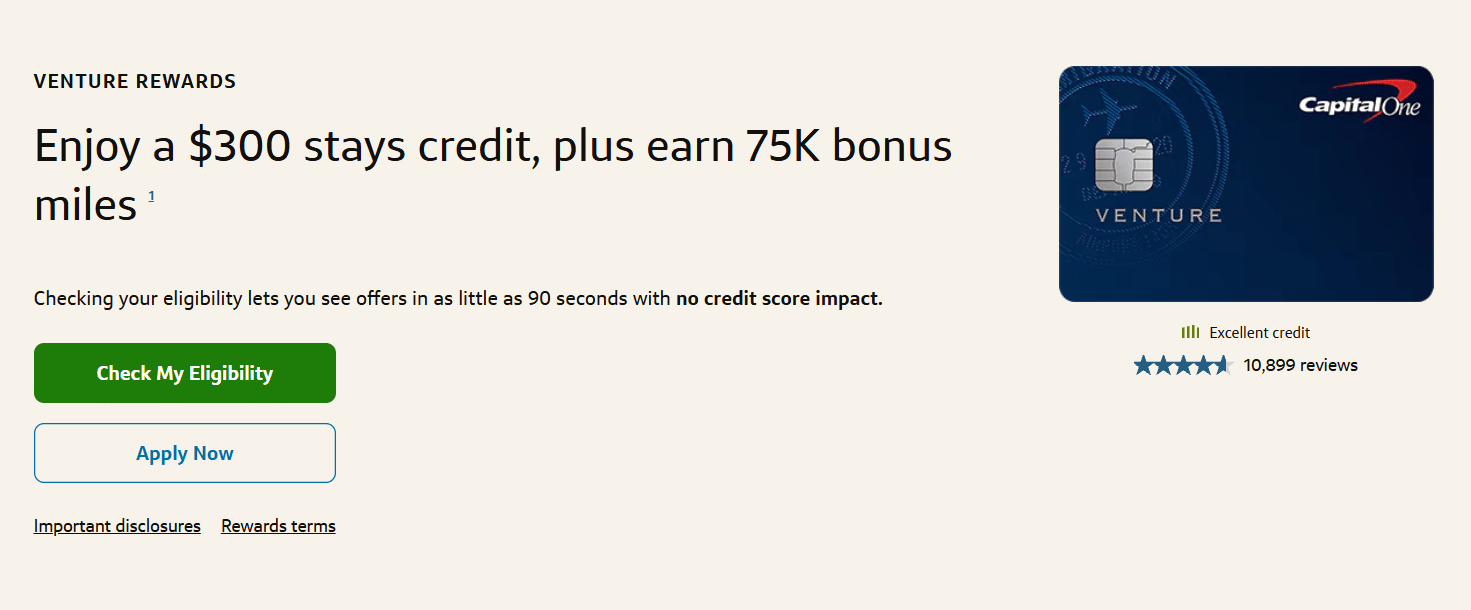
The current welcome offer gives you 75,000 bonus miles after spending $4,000 within the first three months of opening the account.
That’s a higher spending requirement than many cash-back cards, but 75,000 Capital One miles can potentially provide considerably more value than a typical cash bonus, particularly when you use transfer partners.
Once you qualify for the bonus, Capital One says the miles can appear in your account within two billing cycles.
There is also an eligibility restriction to keep in mind. If you have received a new card member bonus on either the Venture or Venture X within the previous 48 months, you may not be eligible for another bonus. Check the specific eligibility terms shown with your offer before applying.
How Capital One Venture Earns Miles
The Capital One Venture keeps its rewards structure relatively simple. You earn 2 miles per dollar on every eligible purchase, with no spending categories to track.
You can also earn 5 miles per dollar on hotels, vacation rentals, rental cars, and activities booked through Capital One Travel. The card also earns 5 miles per dollar on purchases through Capital One Entertainment, which includes eligible concerts, sporting events, and other event tickets.
For example, spending $2,200 per month on eligible purchases at the standard 2 miles per dollar rate would generate 52,800 miles over a year. At a value of 1 cent per mile, that’s about $528 in travel value.
However, the miles can potentially be worth more when you use Capital One’s transfer partners.
Getting More Value From Capital One Miles
One of the biggest features of the Capital One Venture is the ability to transfer miles to more than 15 airline and hotel loyalty programs.
Transfer partners include programs such as Air Canada, British Airways, Air France, Turkish Airlines, and Wyndham. With many partners, Capital One miles transfer at a 1:1 ratio.
When you redeem miles directly toward eligible travel, you will generally get around 1 cent per mile. Other redemption options, such as cash, may provide less value. Transferring miles to an airline or hotel partner can potentially provide more value depending on how you use them.
This can be especially useful for international and premium-cabin flights, where the number of miles required for an award booking can sometimes be substantially lower than the cash price of the same trip.
That’s why a 75,000-mile welcome bonus could potentially provide more than $750 in travel value when transferred strategically.
Combining Capital One Cards
Another useful feature of the Capital One ecosystem is the ability to combine rewards between eligible cards.
If you also have an eligible Capital One cash-back card, such as the Quicksilver or Savor, you may be able to move your cash back into your Venture account and convert it into Capital One miles at a rate of $1 in cash back for 100 miles.
That effectively turns cash-back rewards into transferable miles that can potentially be sent to the same airline and hotel partners.
You don’t necessarily need the $395 Venture X to access Capital One’s transfer-partner system. The $95 Venture can provide access to those partners as well, making it a lower-cost way to participate in the program.

How to Decide If the $95 Fee Is Worth It
Whether the $95 annual fee is worthwhile depends largely on how much you spend and how you redeem your miles.
Compared with VentureOne, the Venture earns an additional 0.75 miles per dollar. At a value of 1 cent per mile, you’d need to spend roughly $12,700 per year for that additional earning rate alone to generate $95 in extra value.
The card also comes with additional benefits that can increase its overall value.
These include up to $120 toward Global Entry or TSA PreCheck once every four years, as well as access to certain lifestyle benefits and complimentary Hertz Five Star status for eligible cardholders.
However, the Capital One Venture doesn’t include the large annual travel credit offered by the Venture X. If you don’t travel much and don’t expect to use the additional benefits, a no-annual-fee card may make more sense.
There are also no foreign transaction fees, making the card useful for international travel. Miles don’t expire while the account remains open.
The variable APR is between 19.49% and 28.49%, so carrying a balance can quickly outweigh the value of the rewards you earn.
How Venture Compares to Venture X and VentureOne
The Capital One Venture sits between the no-annual-fee VentureOne and the premium Venture X.
Venture and Venture X share several features, including a 75,000-mile welcome bonus, 2 miles per dollar on everyday purchases, access to Capital One transfer partners, and the Global Entry or TSA PreCheck credit.
The $395 Venture X adds several premium benefits, including a $300 annual Capital One Travel credit, 10,000 anniversary miles, airport lounge access, access to the Premier Collection, and higher earning rates on eligible hotels and rental cars.
The Venture, by comparison, costs $95 per year and doesn’t include those premium travel benefits.
VentureOne has no annual fee and earns a lower 1.25 miles per dollar on eligible purchases, while still providing access to Capital One’s transfer partners.
This makes the three cards quite different in terms of benefits and costs, even though they share the same broader Capital One miles ecosystem.
Who Is the Capital One Venture For?
The Capital One Venture may appeal to someone who travels several times a year, wants transferable miles, and doesn’t want to pay a premium annual fee for airport lounges and other luxury travel benefits.
It can also work as a lower-cost entry point into the Capital One rewards system. If you already have an eligible Capital One cash-back card, you may be able to move those rewards into your Venture account and convert them into transferable miles.
However, the card won’t necessarily make sense for everyone.
Someone who rarely travels or primarily wants straightforward cash back may prefer a cash-back card. Without using travel redemptions or transfer partners, you may not get as much value from the Venture’s rewards structure.
Likewise, travelers who specifically want airport lounge access and premium travel credits may want to look at the Venture X instead.
And if you regularly carry a credit card balance, a rewards card may not be appropriate because interest charges can quickly outweigh the value of the miles you earn.
How to Check Eligibility Before Applying
Before applying for the Capital One Venture, it’s worth checking whether you’re likely to qualify.
The application results in a hard inquiry, and the card is generally designed for applicants with excellent credit. Capital One allows you to check your eligibility first, which takes about 90 seconds and doesn’t affect your credit score.
Capital One doesn’t publish a fixed rule about how frequently you can apply. However, recent applications, new accounts, and hard inquiries can affect your chances of approval.
Checking your eligibility before submitting a full application can therefore be a useful first step.
Final Thoughts on Capital One Venture
The Capital One Venture combines a large welcome bonus, a simple 2-miles-per-dollar earning structure, and access to Capital One’s airline and hotel transfer partners for a $95 annual fee.
The biggest potential source of additional value comes from transferring miles to travel partners, particularly when you can find redemptions that provide more than 1 cent per mile.
Whether the card makes sense depends on your spending, travel habits, and how you plan to redeem your miles. For someone who wants transferable travel rewards without paying for the premium benefits of a higher-fee card, the Capital One Venture provides a straightforward option to consider.