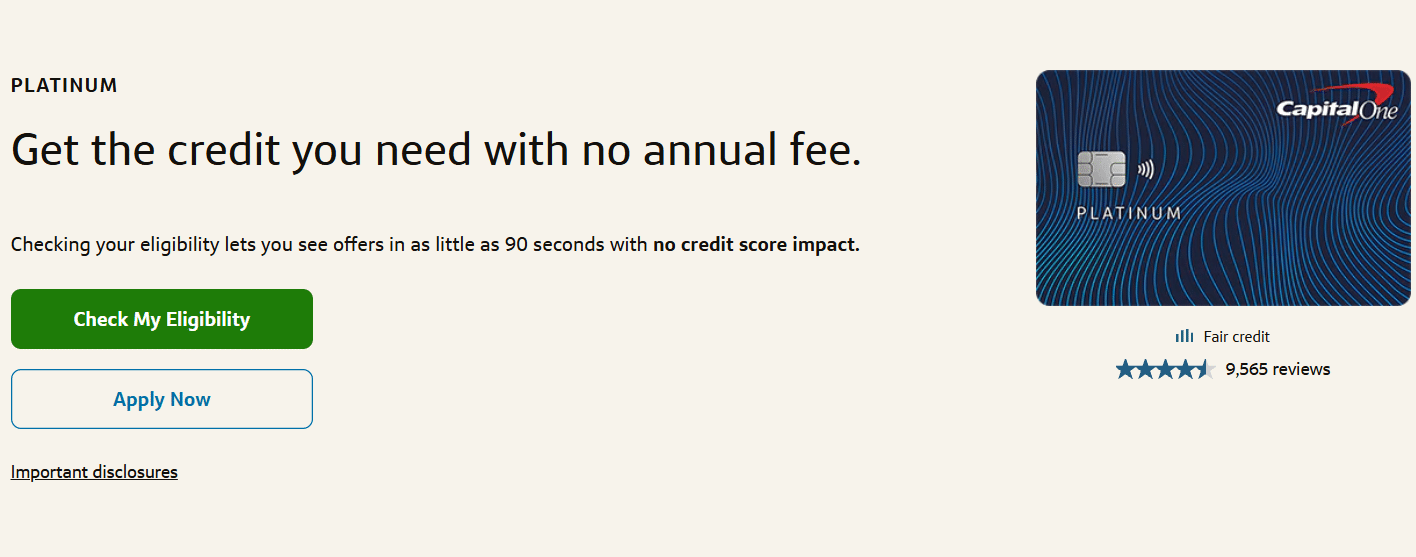
If you’re considering the Capital One Platinum and aren’t sure whether it’s the right fit, the first thing to understand is that this card isn’t designed to earn rewards. Instead, it is primarily a credit-building card for people who may have fair credit and want to establish a stronger credit history.
The Capital One Platinum has no annual fee, doesn’t require a security deposit, and can provide a potential path to better Capital One cards in the future. However, its high APR means it works best when you pay your balance in full every month.
How the Capital One Platinum Helps Build Credit
The biggest thing to know about the Capital One Platinum is that it earns no rewards. There is no cash back, miles, or welcome bonus.
That isn’t necessarily a disadvantage because rewards aren’t the purpose of this card. The Capital One Platinum is designed to help people build credit. It may be an option for someone with fair credit who wants a credit card without having to put down a security deposit.
Approval isn’t guaranteed, but Capital One allows you to check your eligibility before formally applying. This can give you an idea of whether you’re likely to qualify without affecting your credit score.
The card also has a $0 annual fee, so you don’t have to pay simply to keep the account open. Maintaining an open account and making payments on time can help you establish a positive credit history over time.
Capital One may also automatically review your account for a higher credit line after as little as six months of on-time payments. A higher credit limit could reduce your credit utilization if your spending and balances remain the same, which may benefit your credit profile.
Other features include CreditWise credit monitoring, $0 fraud liability, no foreign transaction fees, tap-to-pay functionality, and a 50% discount on drinks at Capital One Cafés.
How to Check Capital One Platinum Eligibility Before Applying
Before submitting a formal application, you can use Capital One’s eligibility-checking tool to see whether you’re likely to qualify. The process can take about 90 seconds and does not impact your credit score.
A formal application generally results in a hard inquiry, so checking eligibility first can be a useful way to avoid applying blindly.
Keep in mind that an eligibility check isn’t a guarantee of approval. Your application can still be evaluated based on additional information when you formally apply.
How to Avoid the High APR
The Capital One Platinum has a high variable APR of 28.99% according to the information discussed in the transcript. There is also no introductory 0% APR period to make carrying a balance more affordable.
Because of that, this card makes the most sense when you treat it as a credit-building tool rather than a source of borrowed money.
For example, you could use the card for a few small purchases and then pay the entire statement balance by the due date. This allows you to use the card while avoiding interest charges on purchases when the balance is paid in full.
Carrying a balance can become expensive quickly with a 28.99% APR. The interest you pay could easily outweigh the benefits of using the card to build credit.
How the Capital One Upgrade Path Works
One potential long-term benefit of the Capital One Platinum is the possibility of eventually moving to another Capital One card.
As your credit profile improves, Capital One may allow you to change your Platinum account to another eligible Capital One card, potentially including a rewards card such as the Quicksilver. This is generally referred to as a product change.
A product change can allow you to keep your existing account open while moving to a card with different benefits. It also typically doesn’t involve applying for a completely new account or receiving another hard inquiry.
However, there is no guaranteed timeline for an upgrade, and Capital One doesn’t guarantee that you’ll be offered a particular card. The six-month timeframe mentioned for account reviews relates to potential credit-line increases, not guaranteed product changes.
For that reason, an upgrade should be viewed as a possible future benefit rather than a promise.

How Capital One Platinum Compares to Quicksilver Secured and QuicksilverOne
The Capital One Platinum isn’t the only option for someone looking to build credit.
If you’re able to provide a refundable security deposit, the Quicksilver Secured card may be worth considering. It has a $0 annual fee and earns 1.5% cash back on purchases, while the security deposit is refundable.
For someone who can comfortably provide the required $200 deposit, Quicksilver Secured offers both credit-building potential and rewards.
Another option is QuicksilverOne. Unlike a secured card, it doesn’t require a security deposit and earns 1.5% cash back. However, it has a $39 annual fee.
At a 1.5% cash-back rate, you’d need to spend roughly $2,600 per year for the rewards to equal $39. Spending more than that could make the cash-back benefit exceed the annual fee, although other factors should also be considered.
This leaves the Capital One Platinum with a relatively specific purpose: providing a no-annual-fee, unsecured card for someone focused primarily on building credit rather than earning rewards.
Who Is Capital One Platinum For?
The Capital One Platinum may make sense for someone who:
- Has fair credit and wants to build a stronger credit history
- Doesn’t want to provide a security deposit
- Wants a card with a $0 annual fee
- Doesn’t need cash back or travel rewards
- Can pay the balance in full every month
- Is interested in potentially moving to a different Capital One card later
The card may be less suitable if you can comfortably put down a security deposit and want to earn rewards. In that case, a secured rewards card could provide both credit-building functionality and cash back.
It may also be worth looking at other options if you want rewards immediately and are comfortable paying a small annual fee.
And if you already have good or excellent credit, you may have access to rewards cards that offer more benefits without needing to start with a credit-building card.
How to Apply Without Guessing Your Eligibility
Before applying for the Capital One Platinum, consider checking your eligibility first. The eligibility tool can help you determine whether you’re likely to qualify without affecting your credit score.
A formal application generally results in a hard inquiry, so it’s worth making sure the card fits your situation before submitting one.
Capital One doesn’t publish a fixed rule for exactly how often you can apply for its cards. However, recent applications, new accounts, and hard inquiries can affect how lenders evaluate your application.
Applying only when the card makes sense for your current credit situation can help you avoid unnecessary applications.
Final Thoughts on Capital One Platinum
The Capital One Platinum isn’t a rewards card, and that’s intentional. Its primary purpose is to give people with fair credit an unsecured, no-annual-fee option for building credit.
There is no cash back, miles, or welcome bonus, but you also don’t have to provide a security deposit. If you use the card responsibly and pay your balance in full every month, it can serve as a straightforward tool for establishing a stronger credit history.
The possibility of eventually moving to another Capital One card can also make the account useful over the longer term, although an upgrade isn’t guaranteed.
Ultimately, the Capital One Platinum makes the most sense when your priority is building credit rather than earning rewards. If you need a simple card with no annual fee and no security deposit, it can serve that purpose, provided you’re disciplined about paying the balance in full.